Industry-Specific AI — Why "Close Enough" Isn't Good Enough in Health Care, Legal Services, or Life Sciences
For regulated industries, generic AI answers aren't just unhelpful, they're risky. Learn why industry-specific AI experts are essential for health care, life sciences, financial services, and more.
The "Close Enough" Problem in High-Stakes Verticals
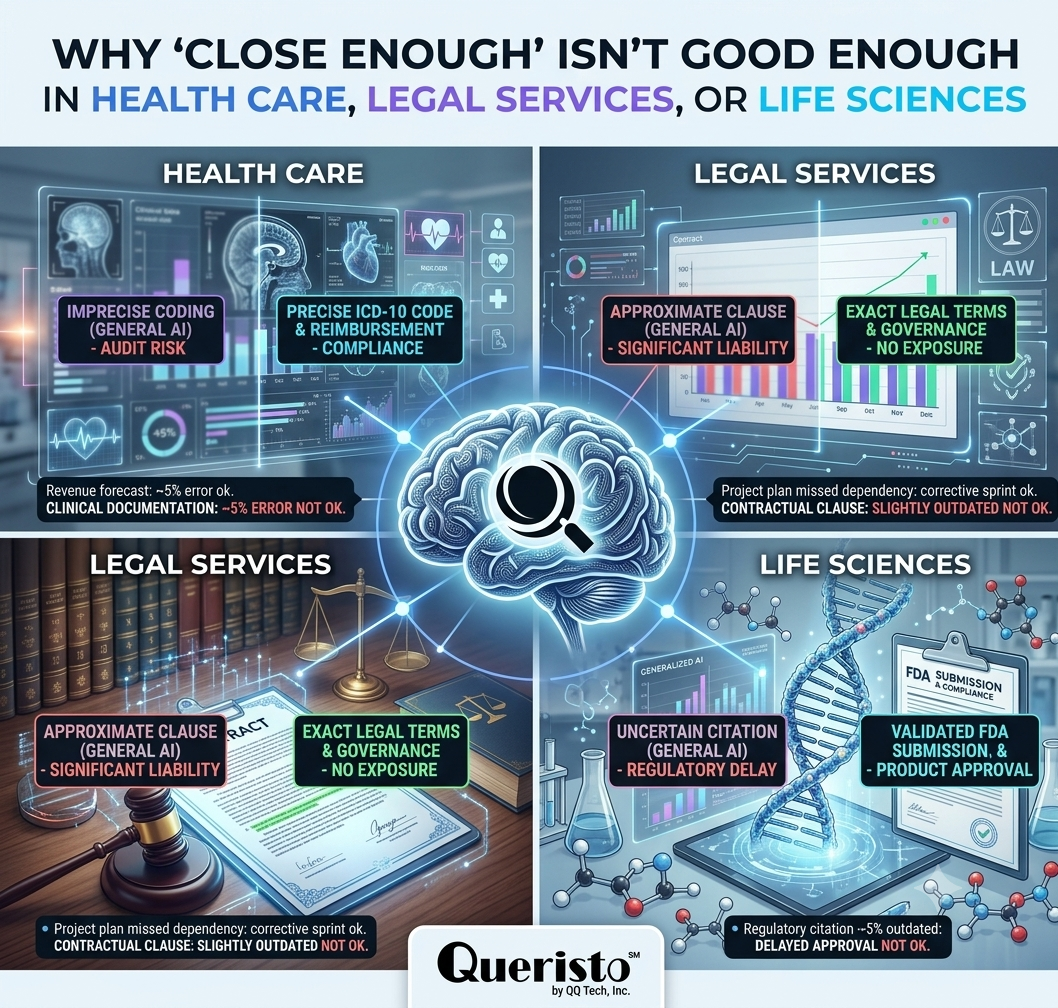
In some professional contexts, a nearly correct answer is acceptable. A revenue forecast that is off by 5% can still inform a reasonable decision. A project plan that misses a dependency can be corrected in the next sprint review.
In other contexts, a nearly correct answer is not acceptable at all. A clinical documentation standard that is almost right can trigger a billing audit. A pharmaceutical regulatory citation that is slightly outdated can delay a product approval. A contractual clause that is close — but not exactly right — can expose an organization to significant liability.
These are the verticals where "close enough" is not a strategy. They are also the verticals where general-purpose AI fails most visibly — and most expensively.
Why General AI Struggles in Regulated Industries
The knowledge required to operate in regulated industries is not just broad — it is precise, current, and highly specific to the regulatory and operational context of that industry. It involves:
- Terminology that does not exist in general training data, or that means something different in an industry context than in general usage
- Regulatory frameworks that change frequently and vary by jurisdiction, subspecialty, or product category
- Institutional knowledge about how regulations are applied in practice — the gap between what a rule says and what it means for day-to-day operations
- Risk thresholds that are lower than in most business contexts, because the consequences of error are larger
General-purpose LLMs are trained on broad internet data. They have some knowledge of these domains — but it is averaged, decontextualized, and often out of date. When a general model encounters a domain-specific query, it does not know where its knowledge ends and its hallucination begins. That uncertainty, invisible to the model, is very visible in the consequences of the output.
Health Care: Where AI Precision Directly Affects Patient and Business Outcomes
Health care is one of the most information-dense industries in the world. Hospitals, clinics, health insurers, and medical equipment companies operate at the intersection of clinical knowledge, administrative process, and regulatory compliance — all at once, all at high stakes.
A Health Care Industry Expert is trained to understand:
- Clinical documentation standards (ICD-10, CPT coding, HCC risk adjustment)
- HIPAA privacy and security requirements at an operational level, not just a definitional one
- Health insurance policy structure, claims processing, and coverage determination logic
- Medical equipment procurement and FDA device classification considerations
- Hospital operations, patient flow, and quality metrics frameworks
The difference between this and a Business Function Expert is depth of vertical knowledge. A Finance & Operations expert can help a hospital analyze budget variance. A Health Care Industry Expert can help that same hospital understand how its case mix index is affecting its reimbursement rate — a question that requires clinical knowledge, financial knowledge, and payor knowledge simultaneously.
Life Sciences & Pharma: Where Regulatory Precision Is the Business
Pharmaceutical and biotechnology companies operate under some of the most stringent regulatory frameworks of any industry. FDA submissions, IND applications, clinical trial protocols, GMP compliance, post-market surveillance — each of these involves a body of regulatory knowledge that is both highly specific and rapidly evolving.
A Life Sciences & Pharma expert is trained to reason within this regulatory environment. It understands:
- The structure and requirements of regulatory submissions (FDA, EMA, and equivalent international bodies)
- GxP compliance frameworks (GMP, GCP, GLP)
- Clinical trial design and protocol documentation standards
- Pharmacovigilance and adverse event reporting requirements
- Nutraceutical and cosmeceutical regulatory distinctions
For a pharmaceutical company, the ability to quickly assess whether a process or document aligns with current regulatory expectations — without waiting on a regulatory affairs specialist for every routine question — represents significant operational value.
Financial Activities: Where Domain Knowledge Is Measured in Basis Points
Banking, investment management, insurance, and real estate are industries where precision is measured in basis points, contractual clauses, and regulatory deadlines. A general AI that "understands finance" at the level of a business news reader is not useful to a fixed income portfolio manager or a commercial real estate underwriter.
A Financial Activities Industry Expert is trained in the specific knowledge domains of:
- Banking regulations (Basel III/IV, Dodd-Frank, AML compliance)
- Investment management frameworks and fiduciary standards
- Insurance policy structure, actuarial concepts, and claims management
- Wealth management and financial planning methodologies
- Fintech regulatory considerations and digital asset frameworks
- Real estate transaction structures and commercial property analysis
Legal Services: Different from Legal & Compliance
It is worth distinguishing between the Legal & Compliance Business Function Expert and the Legal Services Industry Expert.
The Legal & Compliance expert is designed for the legal affairs and compliance functions inside any mid-to-large organization — the in-house team managing contracts, governance, and regulatory adherence.
The Legal Services Industry Expert is designed for law firms, public legal services organizations, paralegals, and legal technology companies — organizations for whom legal practice is the core business, not just one function among many. The knowledge depth required is different in kind, not just in degree.
A law firm needs an expert that understands matter management, billing practices, e-discovery workflows, legal research methodology, and the specific practice area knowledge relevant to their work. A general AI knows that lawyers do these things. A Legal Services expert knows how.
The Activation Model: Demand Before Deployment
Queristo's Industry-Specific Experts are not installed by default. They are activated based on real organizational demand — this is a deliberate design choice.
The reason is efficiency. An expert that is not being used is compute that is not serving a purpose. Queristo's panel model ensures every active expert is earning its place, calibrated to the actual knowledge-work demands of your organization.
This also means that if your industry is not yet in the catalog, or if a specific subspecialty within your industry requires coverage that the current expert does not provide, that is a signal to consider a Custom Expert engagement — purpose-built for your requirements, to your performance specifications.
The Cost of Getting It Wrong
For organizations in regulated industries, the cost of an imprecise AI answer is not just a user experience problem. It is a compliance risk, a patient safety consideration, a regulatory exposure, and a reputational liability.
The right industry expert does not eliminate the need for human review on high-stakes decisions. What it does is dramatically raise the quality of the starting point — ensuring that when your team applies their professional judgment, they are working from a precise, domain-accurate foundation rather than correcting a generalist model's best guess.
Is your industry in our catalog? Review the full expert list and request a scoping conversation with the Queristo team.

-custom-ai.png)